Buying guide
A mug for your usual cup of coffee
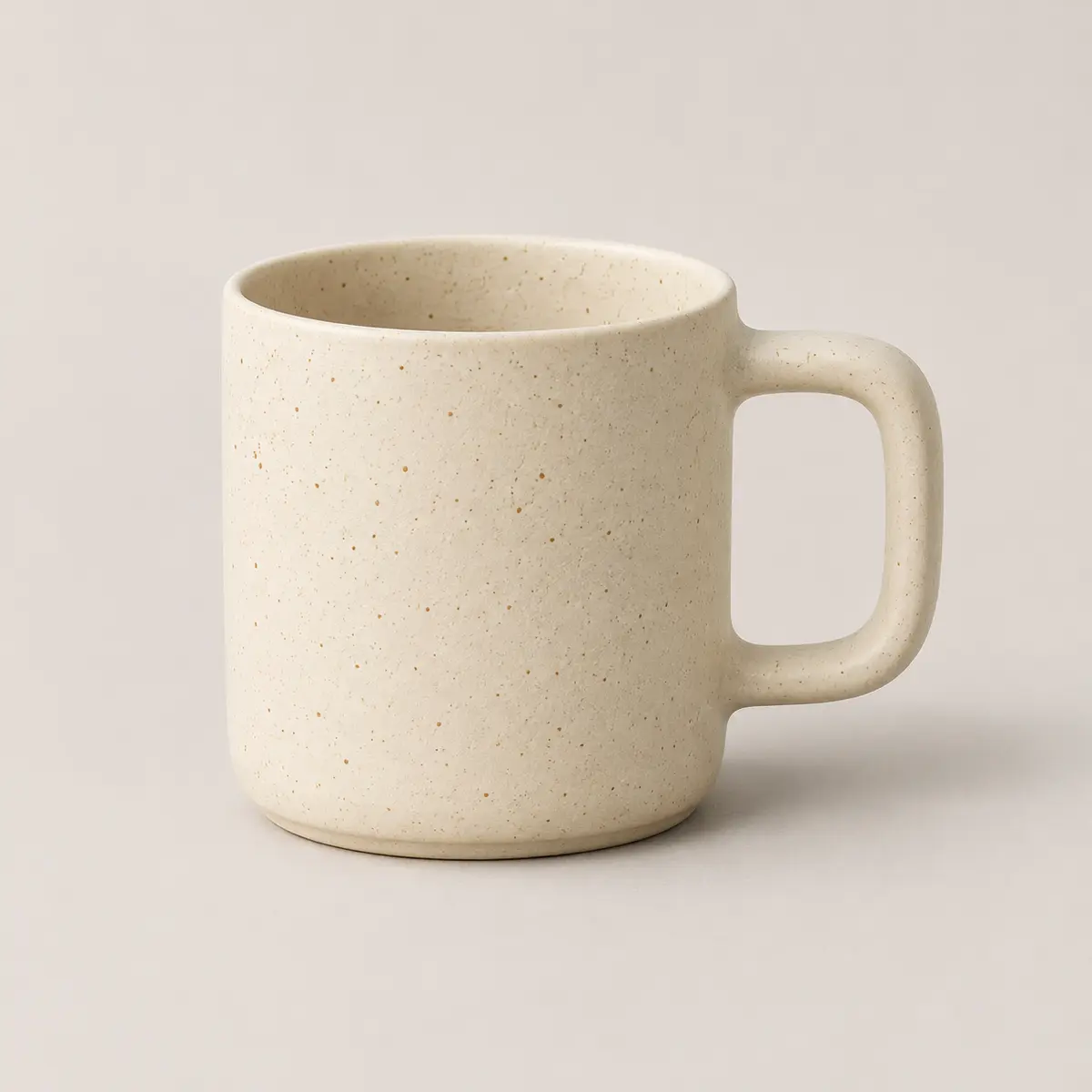
The preview shows a cream stoneware mug with nearly straight sides, and the handle makes a broad loop shaped like a square with rounded corners. Fine speckles are visible near the rim and across the front.
If you hold a mug by curling two fingers through its handle, the opening may matter more to you than the mug’s overall height.
Find a capacity that suits your drink
Use a mug you already own to work out what you need. Make your usual coffee, including any milk, and pour it into a measuring jug. That gives you a serving volume you can compare with a future capacity listing. Leave room between the drink and the rim if you carry it from kitchen to desk. A brimful measurement alone tells you little about how much you would realistically carry.
Check the fit beneath a coffee machine
Measure from the drip tray up to the spout on your machine, with the tray in its normal position. A generous handle also needs room beside the body, especially if another cup sits under a second spout. On a shelf, turn the handle in the direction you normally store it before measuring your available space. The illustration shows the profile of the mug, but cannot establish these clearances.
Choose a finish and check everyday care
The pale surface makes the speckles easy to see, while the handle has the same cream colour as the body. This gives you a reference if you are matching the mug with plain plates or a darker tray. For reheating coffee or cleaning up after breakfast, look for care instructions for the finished mug. Microwave and dishwasher suitability, capacity and handle clearance still need confirmation for an orderable item.
Choose a saucer for the base
If you set the mug on a saucer, measure the flat well at its centre. The mug’s base should rest inside that well before the saucer begins to slope. A coaster has a similar constraint. Measure the flat area that will touch the mug rather than comparing the two items by their widest outlines.