Buying guide
Follow the wires of a balloon whisk
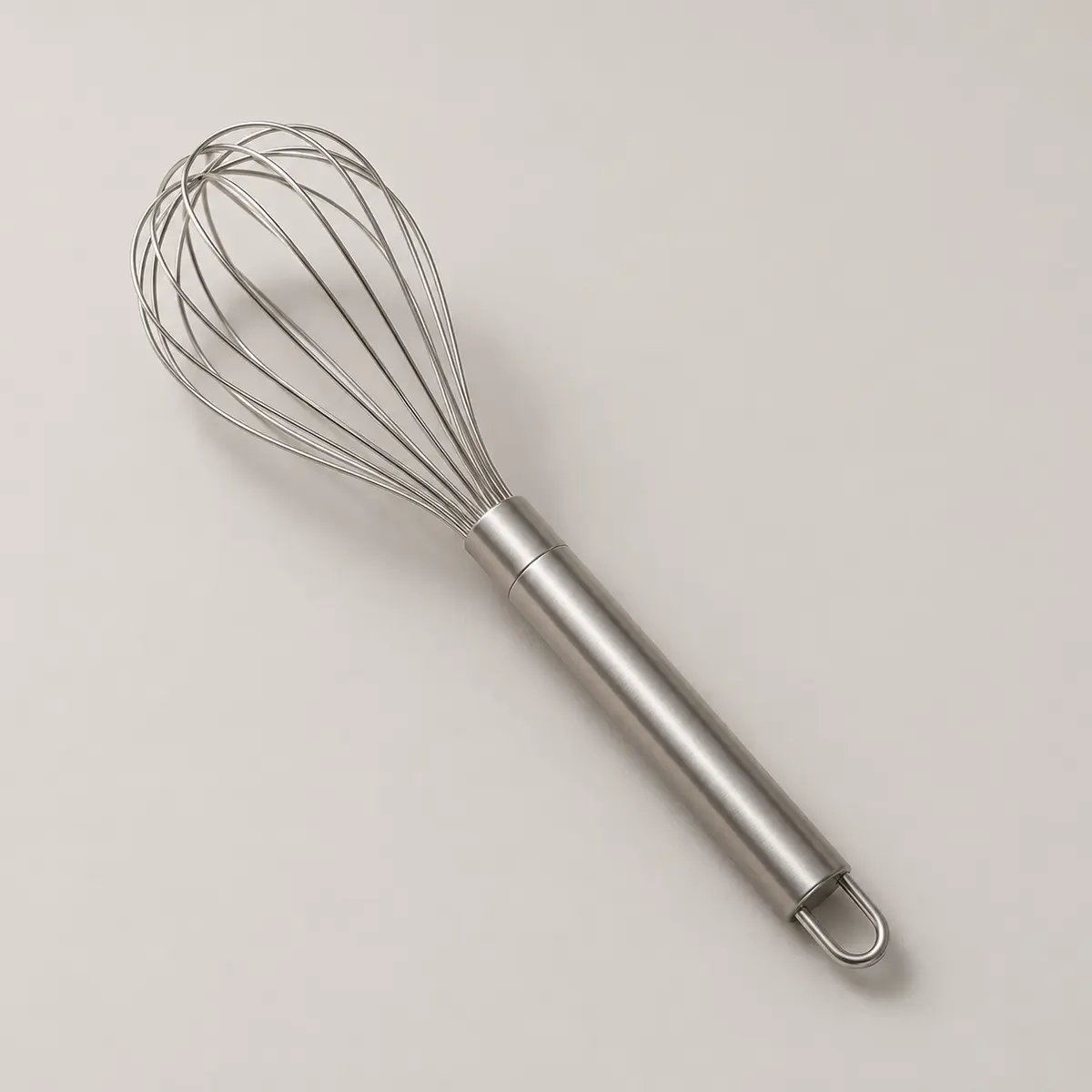
The stainless steel whisk in the preview has wires that bow out into a balloon shape and gather at a cylindrical handle. A small loop projects from the opposite end. You can see the spaces between the wires against the background.
In a mixing bowl, the width of that balloon matters as much as handle length. A whisk chosen for beating eggs in a large bowl may feel quite different in a narrow jug.
Choose for the mixture you make
For a bowl of eggs, allow room to move the whisk back and forth below the surface. For batter, consider the space needed to draw dry ingredients inward from the sides of the bowl. If saucepan sauces are your main task, think about whether the curved head can reach the area where the base meets the wall. The illustrated shape gives a starting point for these comparisons; it does not specify wire stiffness.
Check the bowl and drawer together
Measure the mouth and depth of the bowl you reach for most often. Take a familiar whisk or spoon and hold it at the angle you naturally mix, then note how much handle remains above the rim. The balloon also needs clearance in a drawer. Measuring drawer depth alone misses the height of the dividers or utensils already underneath. Ask for the widest head diameter and overall length before choosing.
Look closely at cleaning and hanging
Mixtures can collect near the point where several wires enter the handle. When comparing actual whisks, look for a clear view of that junction and check how the maker says to clean it. If you hang utensils, compare the handle loop opening with your rail hook, leaving space for the wider head below. Dishwasher suitability, dimensions and compatibility with a coated pan require their own confirmation for the finished utensil.
Mixing a little in a large bowl
For a small quantity, check how much of the whisk head can actually enter the mixture at the bottom of your bowl. A broad rim tells you little about a sharply tapered base. An easy comparison is to pour your usual quantity of water into the empty bowl, then inspect the width of the circle it forms.